Skip to content

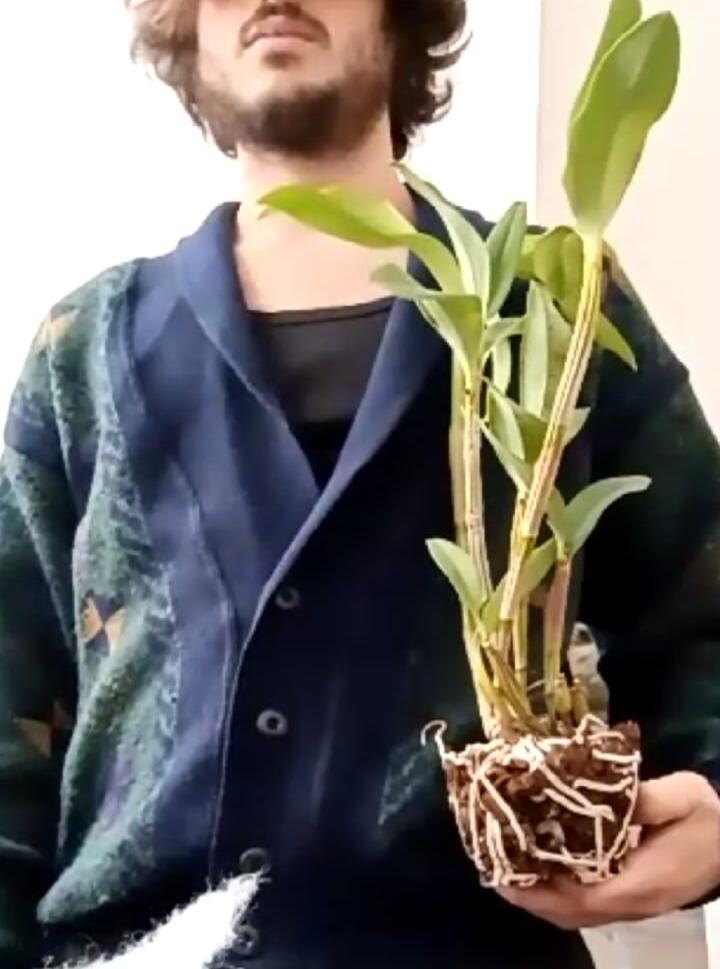
Dendrobium spectabile (14 cm hanging pot)

Blooming strong

Original price 65,00€ - Original price 65,00€
Original price
65,00€
65,00€ - 65,00€
Current price 65,00€

incl. German VAT plus shipping costs
For cross-border deliveries, the rules of the respective EU country apply.

Delivery time:

DE: 2-3 business days (weather permitting)
EU: 3-5 business days (weather permitting)

This image is for illustrative purposes only. The actual plant may differ in shape and color from the image. Plants are shipped without flowers.

Description

Dendrobium spectabile (14 cm hanging pot)

Name: Dendrobium spectabile (Blume) Miq.
Synonyms: Latourea spectabilis Blume; Callista spectabilis (Blume) Kuntze; Dendrobium tigrinum Rolfe ex Hemsl.; Sayeria spectabilis (Blume) Rauschert.
Etymology: spectabile = spectacular, worth seeing — refers to the extraordinary and almost bizarre shape of the flowers.

First description: Originally described in 1849 by Carl Ludwig Blume as Latourea spectabilis, transferred to the genus Dendrobium in 1859 by Friedrich Anton Wilhelm Miquel.
Origin / Distribution: New Guinea, Solomon Islands, Vanuatu, and Bougainville.
Location / Habitat: Mostly epiphytic, rarely lithophytic. It is found in lowland rainforests, mangrove swamps, and mossy mountain forests at altitudes from sea level up to approx. 1100 m. It prefers locations with very high humidity and is often found in exposed areas with plenty of light (e.g., on coconut palms).
Description & Notes: Dendrobium spectabile is a medium-sized to large orchid of the section Latouria. The spindle-shaped, robust pseudobulbs can reach a considerable height of up to 60–100 cm. The flowers are architecturally unique: the sepals and petals are strongly twisted, ruffled, and patterned with complex brown-red markings on a yellowish-green background.
In cultivation, this species requires warm to hot temperatures and high light intensity (brighter than many other Dendrobiums). Constantly high humidity of over 70% and good air circulation are essential. Unlike deciduous species, it does not require a strict dry rest period, but watering should be slightly reduced in winter without allowing the plant to dry out completely.