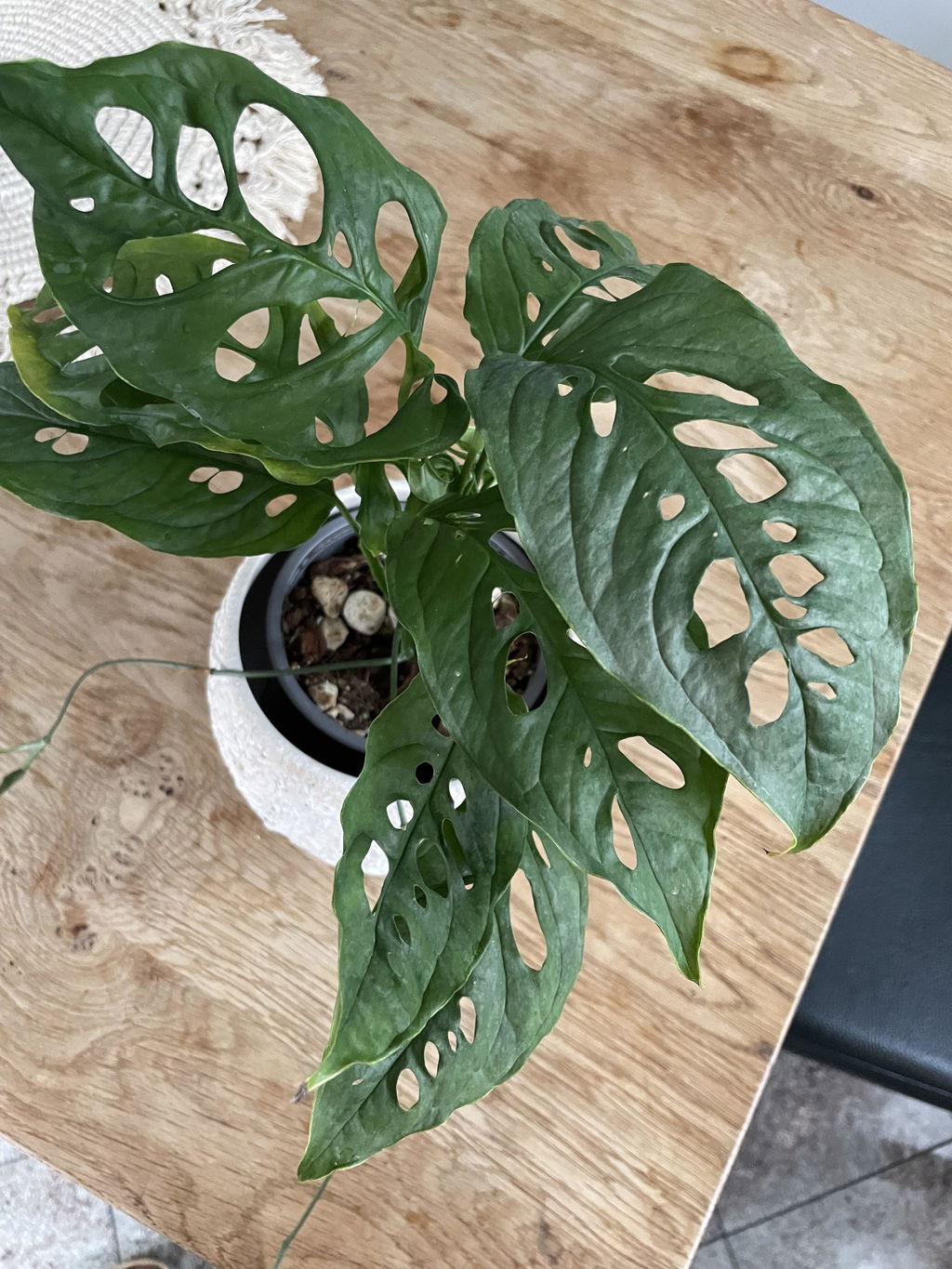
Name: Monstera obliqua, Miq. 1845
Synonyms:
Heteropsis obliqua, Miq.
Heteropsis obliqua, Miq. ex Engl. 1878
Monstera expilata, Schott 1860
Monstera falcifolia, Engl. 1905
Monstera falcifolia var. latifolia, K.Krause 1932
Monstera fendleri, Engl. 1905
Monstera killipii, K.Krause 1932
Monstera microstachys, Schott 1855
Monstera obliqua var. expilata, (Schott) Engl. 1878
Monstera sagotiana, Engl. 1905
Monstera snethlagei, K.Krause 1925
Monstera unilatera, Rusby 1910
Etymology:
obliquus = slanting, oblique
Origin: Peru, Central and South America
Habitat:
hemiepiphytic or terrestrial, widespread in premontane mountain forests with tropical warm-humid climates in the Amazon basin in semi-shaded locations at an altitude of 300-1200m
Notes:
Monstera obliqua is distributed throughout Central and South America. The nominal form has large, round to elliptical leaves and grows in Central America; the further one moves into the Amazon basin, the more frequently plants with pronounced fenestration (slits) are found. Martius described these types in Flora Brasiliensis as Monstera obliqua var. expilata. This variety forms large, closed holes in the leaves. This is how Monstera obliqua differs from Monstera epipremnoides, the so-called skeleton plant, which is open at the leaf edges.